

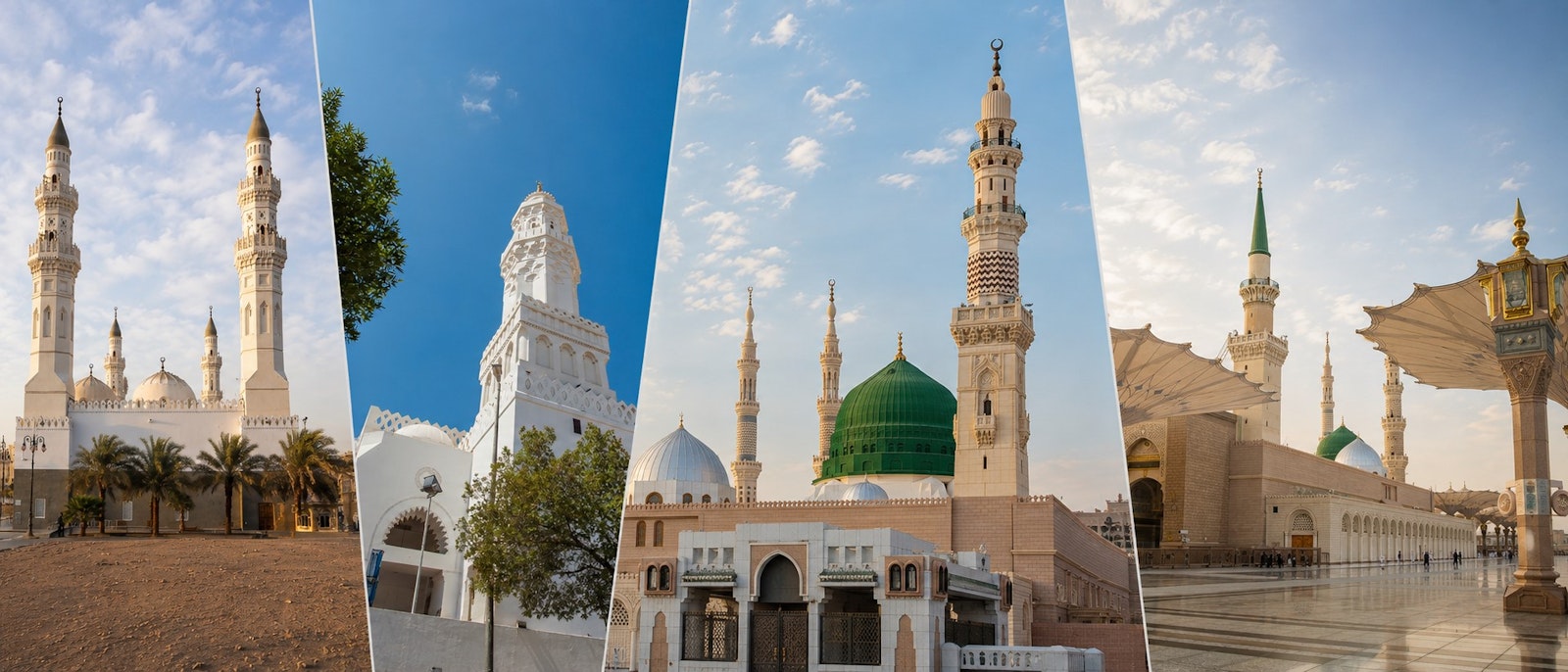
Madinah Ziyarat Guide: Top Historic & Holy Sites
Discovering Madinah’s Sacred History
The Ziyarat of Madinah – the visits to its historic mosques, battlefields, cemeteries, and sacred wells – form a pilgrimage within the pilgrimage. While Masjid an-Nabawi is the spiritual centre around which every Madinah visit is anchored, the city and its surrounding landscape hold layers of Islamic history that reward those who look beyond the mosque walls. This guide covers the most significant sites, the story behind each one, and how to plan your visits practically.
Most pilgrims cover the central Ziyarat circuit in a single half-day guided or private taxi tour. The sites are spread across a radius of 3–5 km from Masjid an-Nabawi, making a combined excursion both logical and efficient. Use the planning table below to map your route before you go.
Site | Distance from Masjid an-Nabawi | Approx. Visit Time | Transport |
|---|---|---|---|
Masjid Quba | 3.5 km south | 30–45 min | Taxi / Ziyarat tour |
Jabal Uhud & Martyrs' Cemetery | 4.5 km north | 45–60 min | Taxi / Ziyarat tour |
Masjid al-Qiblatayn | 4 km north-west | 20–30 min | Taxi / Ziyarat tour |
The Seven Mosques area | 3 km west | 30–45 min | Taxi / Ziyarat tour |
Al-Baqi Cemetery | Adjacent to Masjid an-Nabawi | 20–30 min | Walking |
Bir Uthman (Well of Uthman) | 6 km north | 15–20 min | Taxi |
Date markets (central) | 5–10 min walk from Masjid an-Nabawi | As desired | Walking |
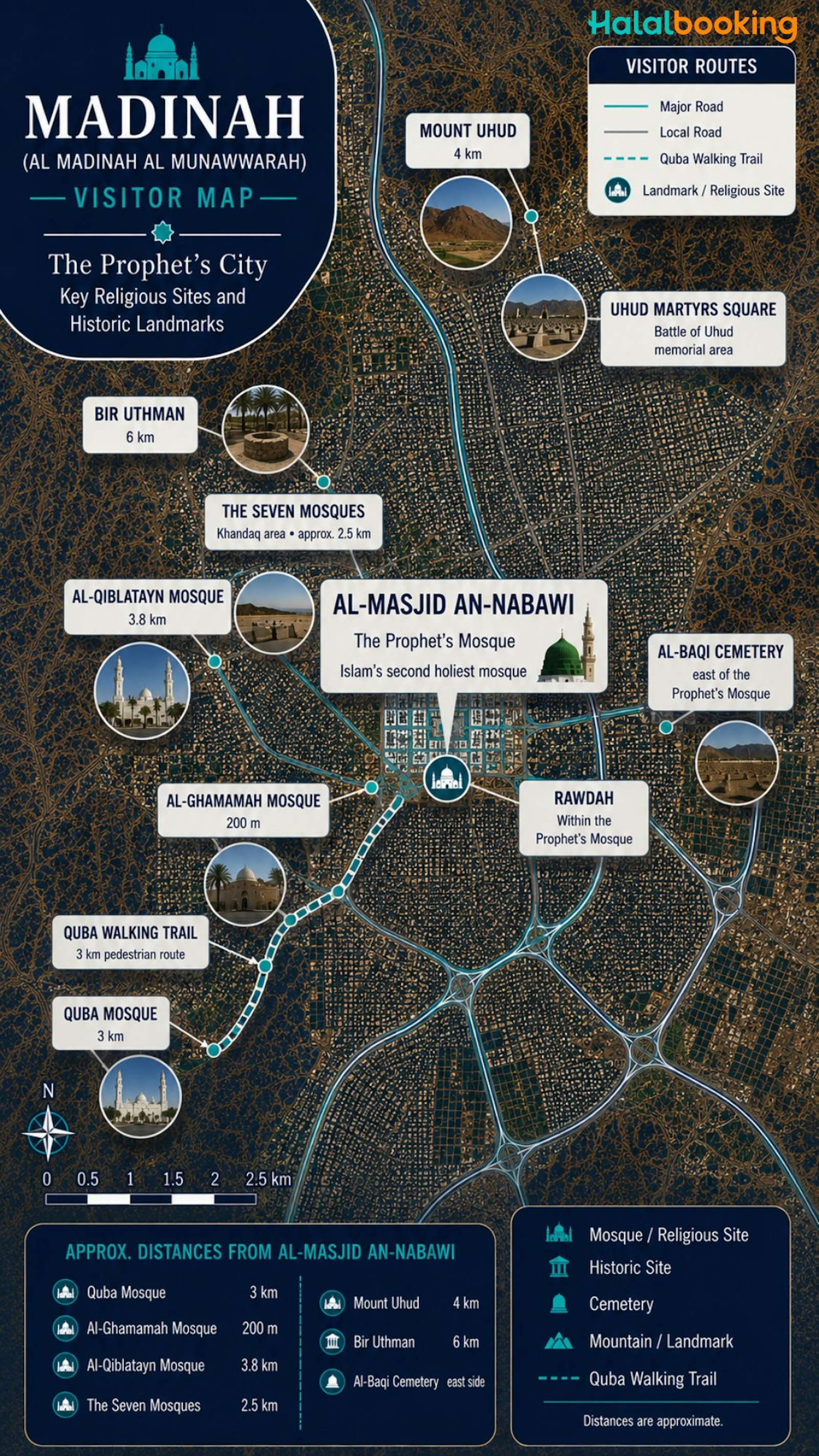
The Spiritual Map: Planning Your Madinah Ziyarat
A well-planned Ziyarat tour covers the essential sites without becoming a rushed tick-list. The standard half-day circuit moves south to Masjid Quba first – the most significant individual site after Masjid an-Nabawi – then north to Jabal Uhud and the Martyrs' Cemetery, before returning via Masjid al-Qiblatayn and the Seven Mosques area. This sequence follows a logical geographical loop and can be completed comfortably in four to five hours with adequate time at each site.
The key logistical decision is transport. Most Ziyarat sites require a taxi or private vehicle – they sit between 3 and 5 km from the central mosque area and are not connected by the free Haramain Bus Service. A private Ziyarat taxi hired for a half-day covers all sites in one trip and allows you to set the pace. Alternatively, organised group Ziyarat tours depart regularly from the hotel district and are a cost-effective option for solo pilgrims.

Time of day
Early morning (after Fajr prayer) and late afternoon (after Asr) are the most pleasant times to visit outdoor sites like Uhud. Midday in summer months can be extremely hot; plan accordingly.

What to bring
Comfortable footwear for walking on uneven ground at Uhud, a modest outer layer for mosque visits, and a water bottle. Prayer rugs are available at most mosques.

Photography
Photography is permitted at most outdoor sites. Inside mosques, be guided by signs and staff instructions – rules vary by location.
Masjid an-Nabawi: The Heart of Madinah
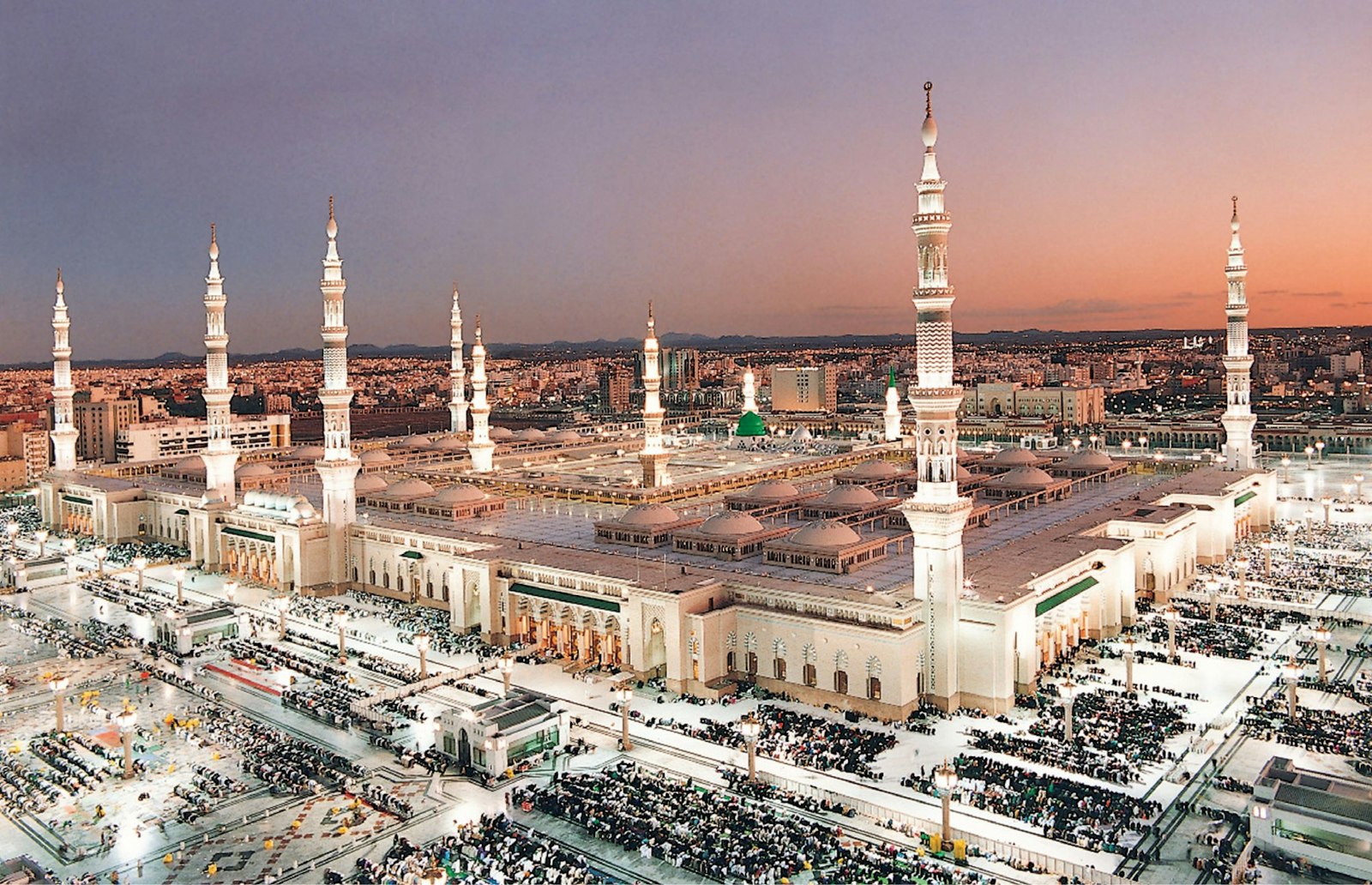
No Ziyarat guide begins anywhere other than Masjid an-Nabawi – the mosque the Prophet Muhammad (PBUH) built with his own hands upon arriving in Madinah after the Hijrah in 622 CE.
The original structure was modest: a simple open courtyard with palm-trunk columns and a roof of palm fronds. What stands today is the legacy of fourteen centuries of expansion and reverence – one of the largest mosques in the world, capable of accommodating over a million worshippers under its iconic retractable umbrella canopies.
At the heart of the mosque lies the Rawdah – the garden between the Prophet's (PBUH) tomb and his original minbar (pulpit). Visiting the Rawdah and offering salawat upon the Prophet (PBUH) at his tomb is the most spiritually significant act a pilgrim can perform in Madinah.
The Green Dome marks the site of the Prophet's (PBUH) resting place, alongside his closest companions Abu Bakr and Umar (RA). For Muslims worldwide, this is among the most emotionally profound places on earth. Allow time here to pray, reflect, and offer salawat without rushing. The spiritual weight of this visit is not measured in minutes.
The Virtues of Masjid Quba: The First Mosque in Islam
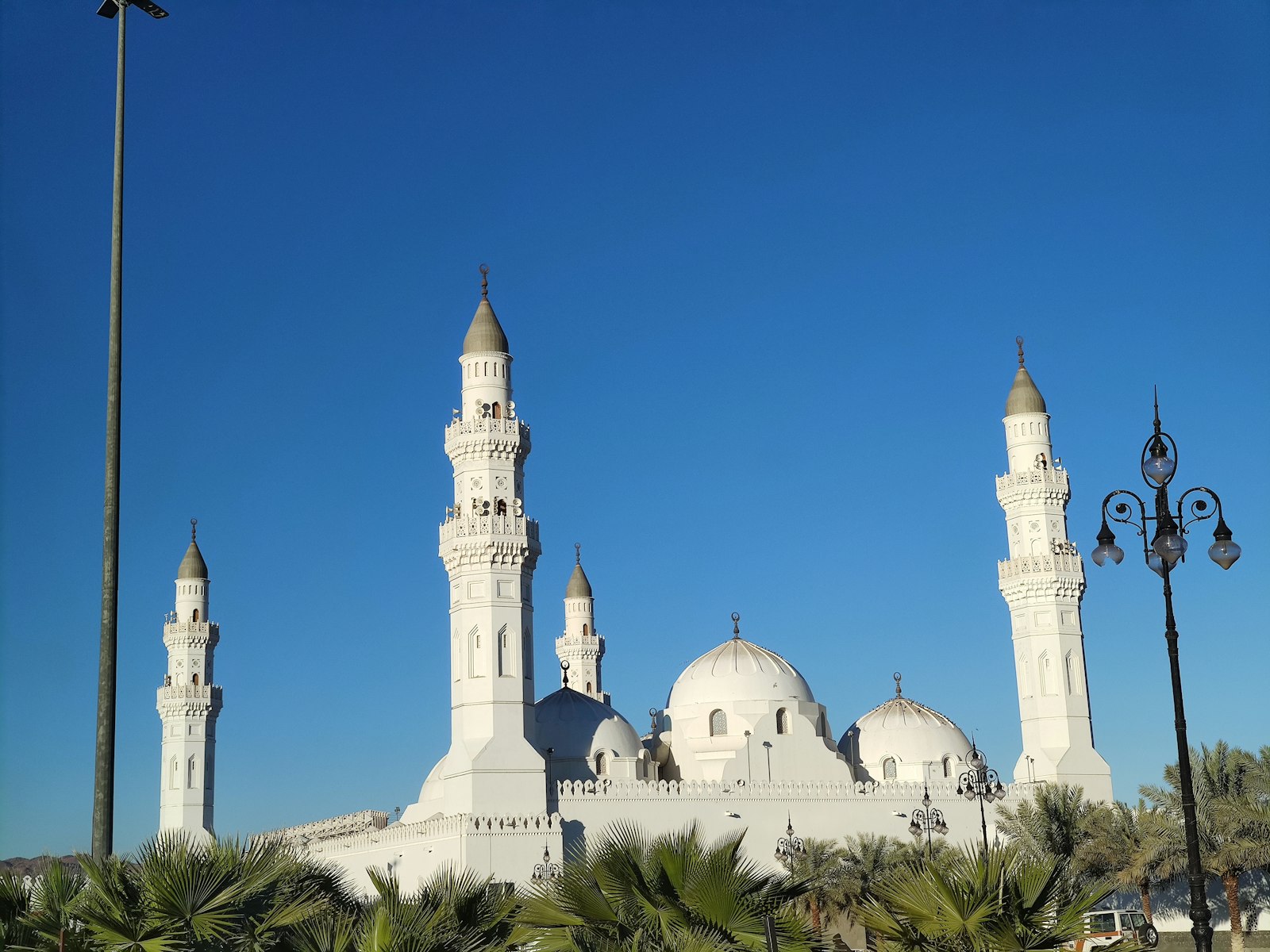
Approximately 3.5 km south of Masjid an-Nabawi, Masjid Quba holds a distinction no other mosque in the world can claim: it was the first mosque ever built in Islamic history. When the Prophet Muhammad (PBUH) arrived in the area of Madinah after the Hijrah, he stayed in Quba for several days before entering the city itself. During this time, he laid the foundation stones of this mosque with his own hands. The Quran affirms its establishment in a verse describing its foundations as built upon taqwa.
Praying two rak'ahs at Masjid Quba is among the most widely practised Sunnah acts associated with Madinah's Ziyarat. For a pilgrim visiting Madinah even briefly, making the short journey to Quba is one of the most spiritually rewarding acts available outside of Masjid an-Nabawi itself.
The current mosque is a spacious, modern structure of white marble, significantly expanded in recent decades. It can accommodate thousands of worshippers and is open to visitors throughout the day outside prayer times. The atmosphere is noticeably quieter than Masjid an-Nabawi, and many pilgrims find the calm here particularly conducive to personal reflection.

"Certainly, a mosque founded on righteousness from the first day is more worthy of your prayers. In it are men who love to be purified. And Allah loves those who purify themselves."
— Surah At-Tawbah 9:108
Ibn Umar (Allah be pleased with them) reported that Allah's Messenger (ﷺ) came to the mosque at Quba' riding and on foot, and he observed two rak'ahs of Nafl prayer in it.
— Sahih Muslim 1399b
The Battle of Uhud: Honouring the Martyrs at Jabal Uhud
Rising 1,077 metres north of Madinah, Jabal Uhud is the mountain at whose base one of the pivotal battles in early Islamic history was fought in 625 CE, three years after the Hijrah. The Muslim army, under the command of the Prophet (PBUH), faced the Quraysh of Makkah here in the Battle of Uhud. What began as a strong Muslim advance faltered when a group of archers abandoned their position on the mountain slope against explicit instruction – a turning point that cost the Muslims dearly and resulted in the martyrdom of approximately 70 companions.
A visit to Uhud is not a tourist excursion – it is an act of remembrance. The mountain itself, the plain where the battle unfolded, and the simple graves of the martyrs carry a solemnity that affects most pilgrims deeply. Allow at least 45–60 minutes here: time to walk to the main graves, offer salutations, and sit in quiet reflection before the landscape that witnessed these events.
Visit detail | Information |
|---|---|
Distance from Masjid an-Nabawi | 4.5 km north |
Time needed | 45–60 minutes |
Entry fee | None |
Permit required | No |
Best time to visit | Early morning (post-Fajr) or late afternoon (post-Asr) |
Dress code | Modest dress throughout |
On site | Vendors selling Ziyarat maps, dates, and small souvenirs |
Transport | Private taxi or organised Ziyarat tour |
Historic Mosques: Masjid al-Qiblatayn and the Seven Mosques
Beyond Masjid Quba, Madinah contains several smaller historic mosques that carry their own significant stories – sites that a thorough Ziyarat tour includes as a matter of course.
Masjid al-Qiblatayn
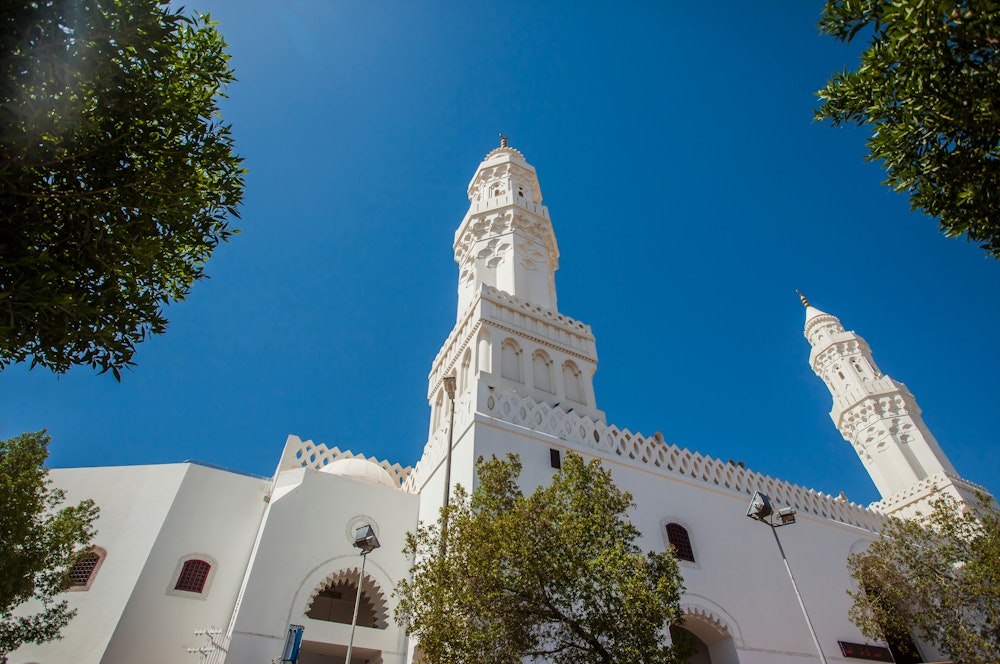
Named for the event that took place within its walls. In the second year of Hijra, during a prayer led by the Prophet ﷺ, a Quranic revelation arrived commanding Muslims to turn from Al-Quds towards the Masjid al-Haram in Makkah as the new direction of prayer. The congregation pivoted mid-prayer — an event of profound theological and historical significance that the mosque's very name commemorates.
The Seven Mosques (Masajid Sab'ah)
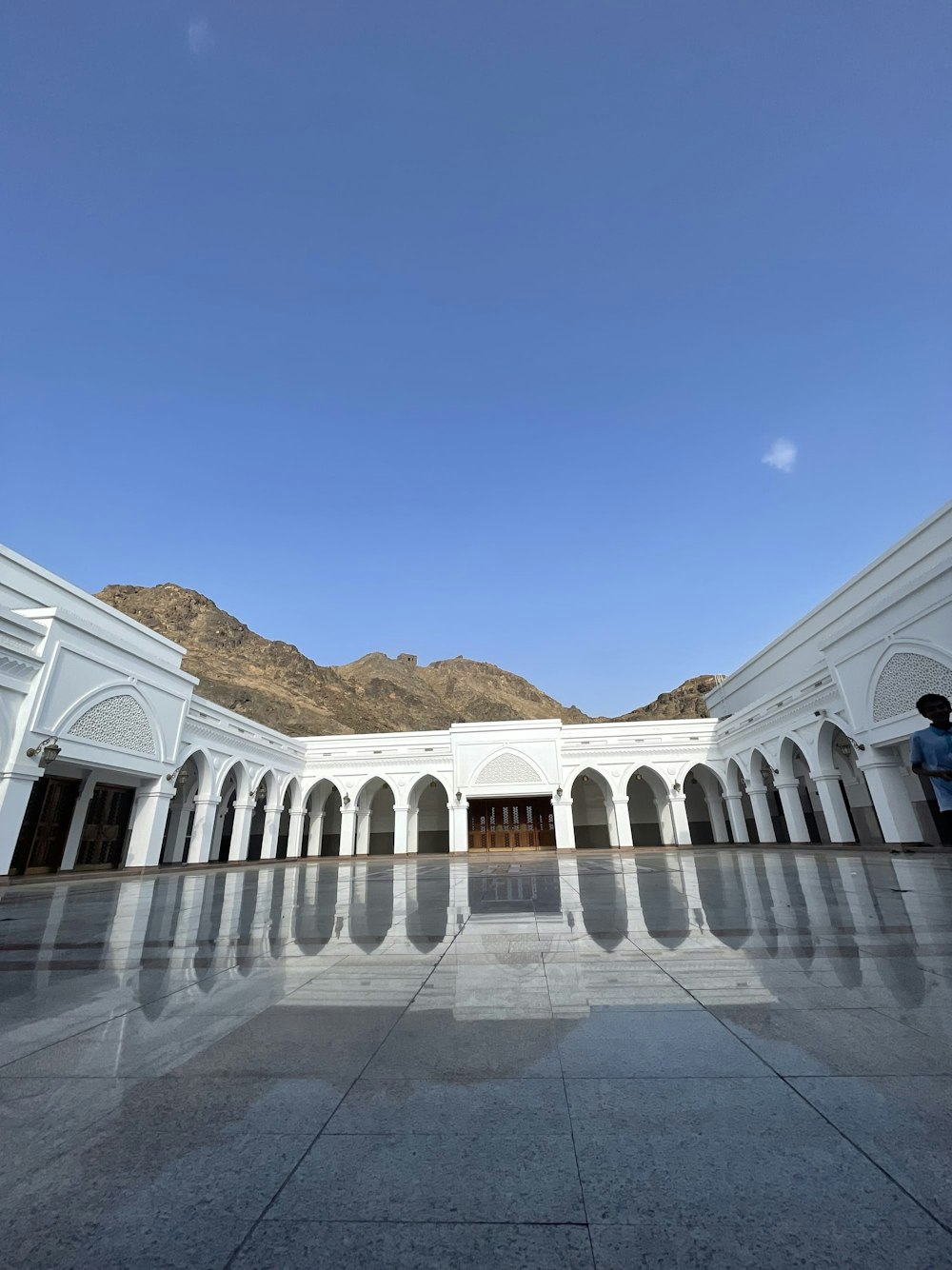
A cluster of small mosques approximately 3 km west of Masjid an-Nabawi, built near the site of the Khandaq (Trench) — the defensive trench dug by the Muslim army at the instruction of Salman al-Farisi (RA) during the Battle of the Trench (627 CE). The mosques mark spots associated with prayer locations of the Prophet ﷺ and his senior companions during the siege. Worth visiting primarily for its connection to this pivotal moment.
Gardens and Wells: Exploring the Hijrah Landscapes
Madinah's Hijrah landscape extends beyond its mosques and battlefields to the gardens, orchards, and wells that appear in Islamic historical accounts – places that formed part of the daily life of the early Muslim community and carry their own quiet significance.
Al-Baqi Cemetery (Jannat al-Baqi)
Madinah's main historic cemetery, immediately east of Masjid an-Nabawi. The purpose of the visit is defined in the Sunnah: remembrance of death and the life to come, and Dua to Allah for forgiveness and mercy for those buried there. Nothing more is required, and nothing less is sufficient.
Bir Uthman (Well of Uthman)
According to historical accounts, the well was privately owned and sold to Muslims at inflated prices. Uthman purchased it and donated it as a public water source for the Muslims of Madinah, fulfilling a request from the Prophet (pbuh).
Date Souks Near the Mosque
It's a special tradition for pilgrims. The Ajwa date is Madinah's most valuable type of date. You can buy it at stalls near every mosque. There are also wholesale markets on the outskirts of the city. These have a bigger selection and better prices.
Frequently Asked Questions
Practical answers for planning your Madinah Ziyarat
What is the best sequence for a half-day Madinah Ziyarat tour?
The most efficient half-day route begins with Masjid Quba (south), then moves to Jabal Uhud and the Martyrs' Cemetery (north), followed by Masjid al-Qiblatayn (north-west), and finishes with the Seven Mosques area (west) before returning to the central mosque area. This loop avoids backtracking and covers the four main sites in approximately four to five hours. Al-Baqi Cemetery is adjacent to Masjid an-Nabawi and can be visited on foot before or after the main tour – early morning after Fajr is the preferred time. Bir Uthman can be added on the northern leg of the route if time allows. Arrange a private Ziyarat taxi for the full circuit rather than individual journeys – it is more cost-effective and allows you to set the pace at each site.
Do I need a permit to visit Masjid Quba or Mount Uhud?
No permit is required to visit Masjid Quba or Jabal Uhud. Both are open to all Muslim visitors without advance booking or official permission. Access is managed by attendants at each site, and visiting hours are generally aligned with standard daytime hours outside of prayer times. The Rawdah visit inside Masjid an-Nabawi is the only Ziyarat-related experience in Madinah that requires an advance booking – through the Nusuk App. All other sites in the standard Ziyarat circuit are accessible on a walk-in basis.
How much does a private taxi for Ziyarat usually cost?
A private half-day Ziyarat taxi covering the main circuit – Masjid Quba, Uhud, Masjid al-Qiblatayn, and the Seven Mosques – typically costs SAR 80–150 for a 4-seater vehicle for the full half-day. Agree the complete itinerary, total price, and estimated duration before departing. For groups of five to seven, an MPV or larger taxi runs approximately SAR 120–200 for the same circuit. Prices rise during Ramadan and Hajj season; pre-booking is advisable.
Is it possible to visit the Baqi Cemetery daily?
Yes, Al-Baqi Cemetery is open daily, though visiting hours differ for men and are subject to change by Saudi authorities. Men are generally permitted entry in the early morning (after Fajr) and in the late afternoon or evening. No permit or advance booking is required; access is managed by guards at the main entrance gate. The visit requires quiet and respectful conduct throughout; photography inside the cemetery is not permitted. Women's access is not available.
Your pilgrimage in the safest hands online
The world's #1 halal-friendly booking platform. Officially aligned with Saudi authorities, airline and lifestyle rewards programmes.






Scan the QR code with your phone camera to download it.


Plan Your Madinah Stay with Halalbooking
The Ziyarat sites of Madinah repay those who arrive with knowledge and time. Stay close to the central area and book a private taxi for maximum flexibility on the half-day circuit.