

How to Book Rawdah Permits: Step-by-Step Nusuk App Guide
What is the Rawdah and Why is a Permit Mandatory?
The Prophet (SAW) said, "There is a garden from the gardens of Paradise between my house and my minbar, and my minbar is on my Lake Fount."
Agreed Upon by Bukhari, Muslim and Tirmidhi
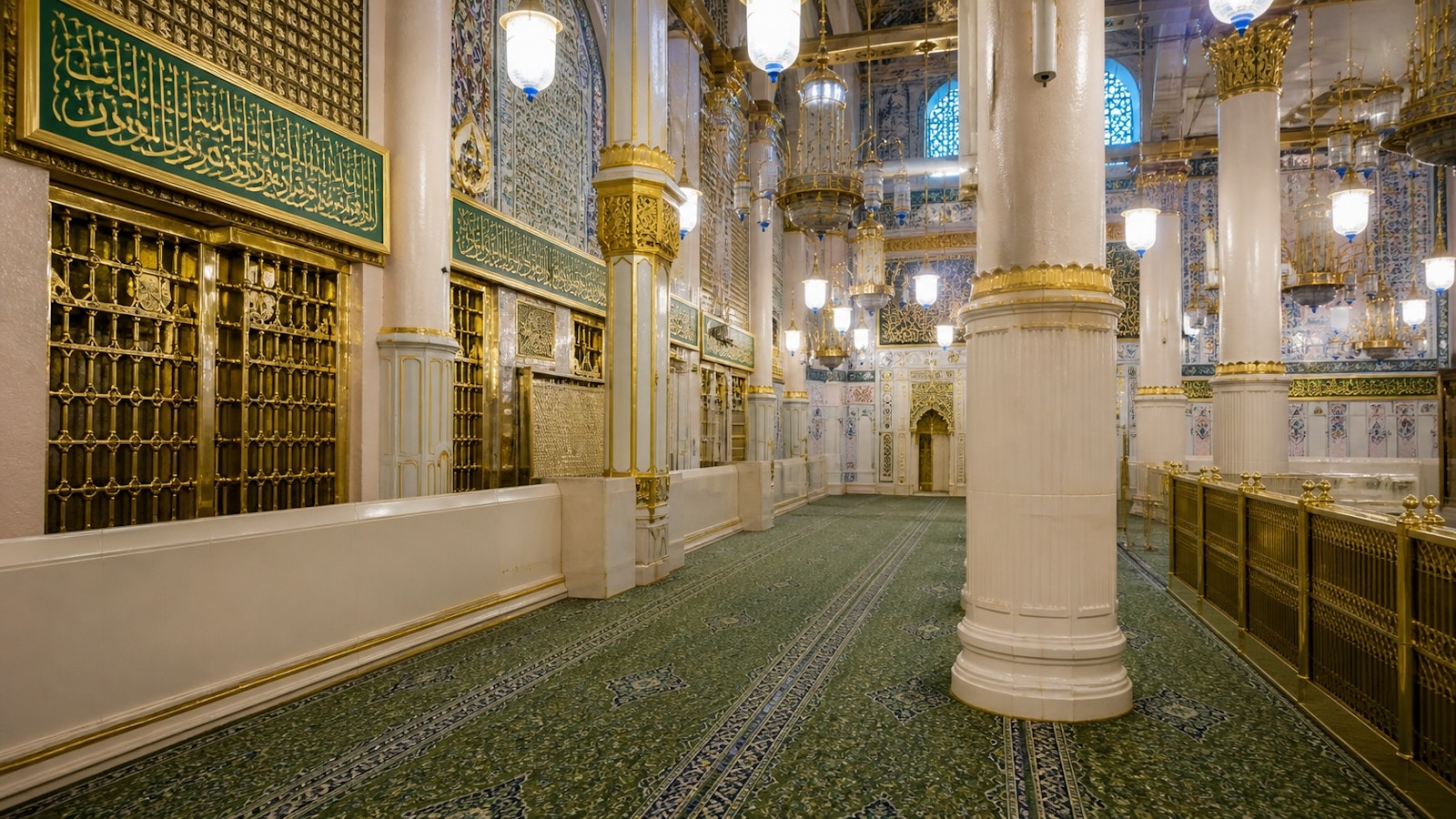
The Rawdah Al-Sharifah – literally "the noble garden" – is the area inside Masjid an-Nabawi that lies between the Prophet's (PBUH) original pulpit (minbar) and the chamber where he is buried. It is one of the most sought-after destinations for any pilgrim arriving in Madinah.
Access to the Rawdah is managed by the Saudi authorities through a timed-entry permit system, administered via the Nusuk App. The permit system was introduced to ensure that all pilgrims can visit in a controlled, dignified environment – and to prevent overcrowding in a space that holds enormous spiritual significance. Without a valid permit and QR code, entry to the Rawdah area is not permitted.
Permits are free of charge. There are no fees attached to the booking. The process is entirely managed through the official Nusuk platform; any third-party service charging for Rawdah booking access should be avoided.
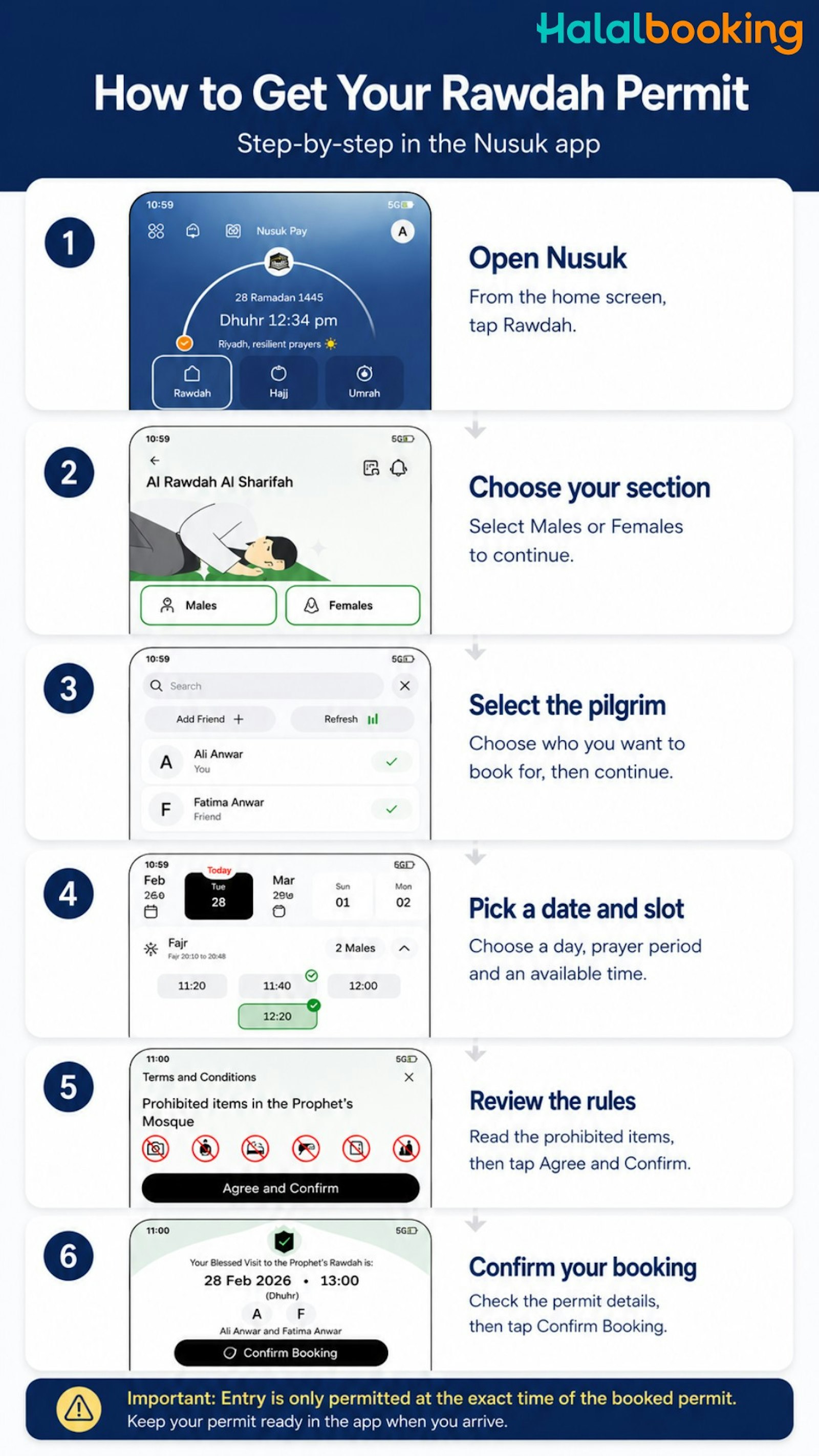
Step-by-Step: Booking Your Rawdah Slot on the Nusuk App
Before you begin, ensure your Nusuk account is fully set up and your passport details are verified. Rawdah permits are linked to your account profile; an incomplete account cannot complete the booking.
Step | Action | What you do | Timing | Why it matters |
|---|---|---|---|---|
1 | Open the Nusuk App and tap "Book Rawdah Visit" | Tap Services, then Book Rawdah Visit — separate from the Umrah permit section | ~30 seconds | Confusing the two sections is the most common first-time mistake |
2 | Pick your date from the calendar | Empty or greyed-out calendars are normal — slots release 7–14 days before the date (3–5 days in Ramadan and Dhul-Hijjah) | Check daily until slots appear | Waiting until your travel week to look means you may arrive without a permit |
3 | Choose your time slot | Sessions are gender-segregated; each lasts 30–45 minutes and is strictly enforced. Men: early morning and late evening. Women: late evening after Isha and some afternoon windows | Be ready to book in seconds | Slots fill within minutes of release during peak season |
4 | Save your QR code permit | A QR code is issued to your account on confirmation. Screenshot it straight away and save the image to your phone gallery | Do this immediately | Connectivity inside Masjid an-Nabawi can drop — an offline copy is essential at the gate |

Key tip
Rawdah slots fill within minutes of release. Set a daily reminder to check the app from 10 days before your intended visit date. When availability appears, book immediately.
Visiting the Rawdah for Women: Designated Times and Gates
Women access the Rawdah through segregated, Nusuk-booked sessions. Timings, which differ from men's, vary seasonally, so check the app for current availability. Typical women's sessions are late evening after Isha or mid-afternoon between Dhuhr and Asr. Additional slots may be added during peak seasons.
Entry for women is via the northern gates of Masjid an-Nabawi, designated for the women's section. Mosque staff will direct you to the correct Rawdah queue entrance.
The women's Rawdah section is adjacent to the main area, near the Prophet's (PBUH) tomb. Though session duration is fixed, arrive composed to maximize the meaningfulness of the visit.
Practical guidance for women
- Wear full, loose-fitting abaya and ensure your hijab is secure before joining the queue – there is no facility to adjust dress inside the Rawdah area
- Avoid carrying large bags; small personal items only
- Perfume is not permitted inside Masjid an-Nabawi
- Mobile phones may be carried but photography inside the Rawdah area is not permitted
Troubleshooting: What to Do When "No Permits Available" Shows
Seeing "No Permits Available" is the most common frustration pilgrims encounter with Rawdah booking. In most cases, it does not mean permits are genuinely exhausted – it means slots for that date have not yet been released.
Problem | Solution |
|---|---|
If the calendar is empty | Rawdah slots are released on a rolling basis, typically 7–14 days before the date; during peak periods, as little as 3–5 days ahead Return to the app daily and check in the morning – new slots are often added overnight Saudi time Do not assume your dates are unavailable; keep checking until 2–3 days before |
If slots appear but do not confirm | Ensure your internet connection is stable before attempting to book Avoid booking during Friday prayers or peak mosque-entry times when app traffic is highest Try switching between Wi-Fi and mobile data if the app stalls |
If your permit disappears after booking | Navigate to "My Profile" → "My Bookings" – your confirmed Rawdah appointment with QR code should appear here Pull down to force a data refresh Log out and log back in; this resolves most display errors Check your registered email address – Nusuk sends a confirmation email with permit details that can be saved or printed as backup |
If the verification code is not arriving | Ensure your mobile number is entered with the full international dialling code (e.g., UK +44, TR +90, FR +33, GR +30, RU +7, UAE +971) Check that your mobile provider has international SMS enabled Wait 10–15 minutes and request the code again As a last resort, contact Nusuk support on +966 920002814 (available 24 hours) or use the in-app live chat via "Help" → "Live Chat" |
Etiquette and Conduct During Your Visit to the Prophet’s Garden
It is important to approach the Rawdah with the right understanding. The Rawdah is a blessed area within Masjid an-Nabawi – not a separate mosque, and not a fourth site of pilgrimage.
The Prophet (PBUH) specified only three mosques to which a religious journey may be undertaken:
"Do not undertake a journey to visit any Mosque, but three: this Mosque of mine, the Mosque of al-Haram and the Mosque of Aqsa (Bait al-Maqdis)." (Sahih al-Bukhari 1189; Sahih Muslim 1397).
The Rawdah's significance flows from being part of Masjid an-Nabawi – one of these three – not from being a destination in its own right.
The Prophet's (PBUH) final warning
Aisha (RA) reported that the Prophet (PBUH), in his final illness, said:
"Allah cursed the Jews and the Christians because they took the graves of their Prophets as places for praying" (agreed upon by Sahih al-Bukhari, Sahih Muslim 529, Sunan an-Nasa'i 2047).
She added that it was for this reason that the grave of the Prophet (PBUH) was not made prominent. The Companions, and the generations after them, preserved his grave with this in mind from the very beginning.
What this means for your visit
The classical scholars across all four madhabs built their visitation guidance around this hadith. The unifying principle is straightforward: avoid any act that resembles directing worship towards the grave itself.
Specifically:
- Do not touch, kiss, or rub against the walls of the chamber.
- Do not stand at the grave for prolonged periods. The Companions visited only briefly when entering or leaving Madinah.
- Do not bow towards the chamber.
- Do not circumambulate the grave. Tawaf is for the Kaaba alone.
- Do not face the grave when offering your prayer. Even where no building is involved, turning to face a grave in prayer falls within the warning of the hadith.
How to make your visit
- Send greetings upon the Prophet (PBUH).
- Then move on, so others may do the same.
Frequently Asked Questions
Practical answers about the Rawdah booking process
How many days in advance should I check for Rawdah permits?
Start checking the Nusuk App 10 days before your intended visit date. Rawdah slots are typically released 7–14 days ahead – during Ramadan and Dhul-Hijjah, this window can shorten to 3–5 days. Check the app every morning, as new availability is often added overnight. When slots appear, book immediately – they fill within minutes of release.
Can I visit Rawdah more than once in a single trip?
Yes, in principle. There is no fixed limit on the number of Rawdah visits per trip as of 2026. However, the system generally allows only one active booking at a time – once your visit is completed, you can attempt to book again. During peak seasons, the system may prioritise first-time bookings to give more pilgrims access. Availability permitting, multiple visits during a single Madinah stay are possible.
What is the best time for women to visit Rawdah?
Women's Rawdah sessions are most commonly allocated in the late evening after Isha prayer and in certain mid-afternoon windows. The late-evening sessions tend to have slightly lower crowd pressure than the afternoon slots, though this varies by season. Check current session timings directly in the Nusuk App when booking, as schedules are adjusted by Saudi authorities throughout the year.
What should I do if the Nusuk app verification code is not sending?
First, confirm your mobile number is entered with the correct full international dialling code (e.g., +44 for UK). If the code still does not arrive, check that international SMS is enabled on your plan, clear your SMS cache, wait 10–15 minutes, and request the code again. If the issue persists, contact Nusuk support on +966 920002814 or use the in-app live chat. Purchasing a local Saudi SIM card or eSIM on arrival significantly reduces OTP delivery issues for the duration of your trip.
Your pilgrimage in the safest hands online
The world's #1 halal-friendly booking platform. Officially aligned with Saudi authorities, airline and lifestyle rewards programmes.






Scan the QR code with your phone camera to download it.


Plan Your Madinah Stay with Halalbooking
Securing a Rawdah permit is easier when you are staying close to Masjid an-Nabawi. A hotel within walking distance means you can respond quickly when slots become available.