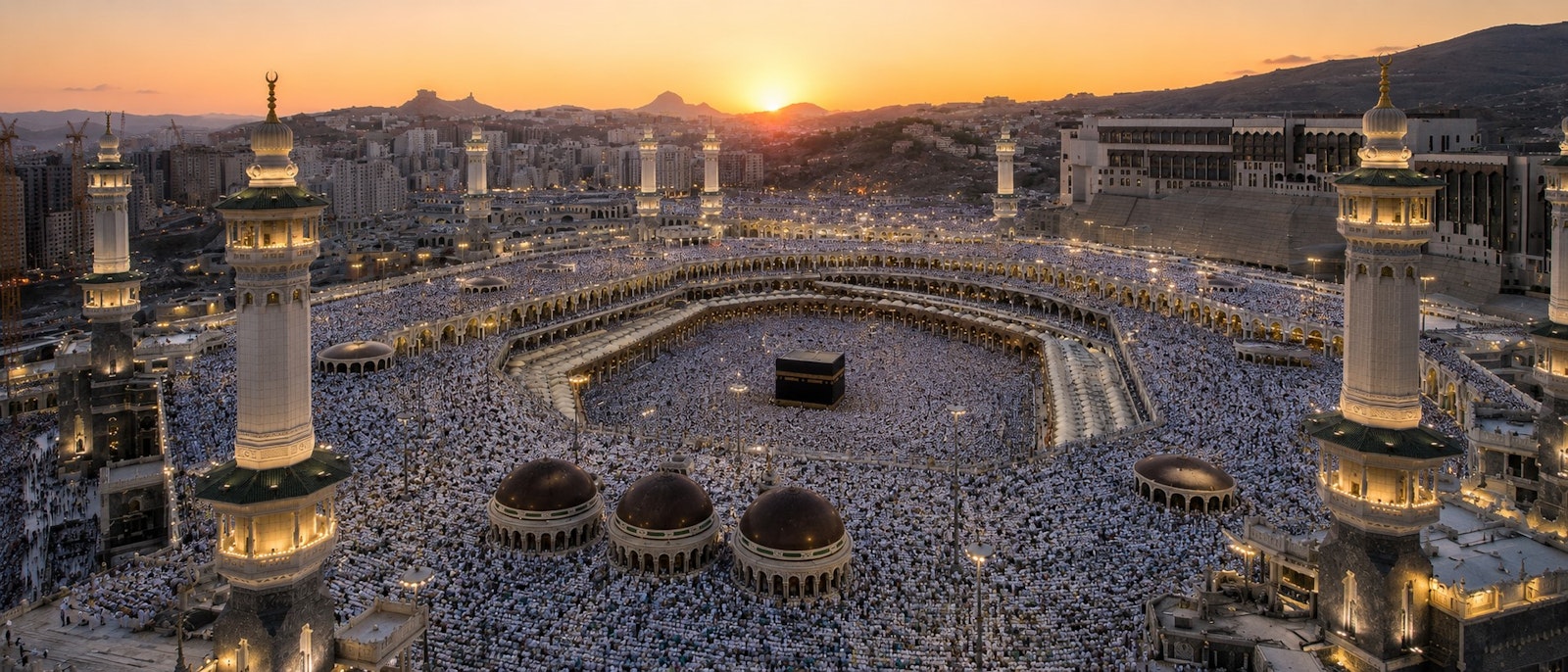
Umrah follows a precise, chronological sequence — Ihram, Tawaf, Sa‘i, and Tahallul — and each stage must be completed in order. This guide walks you through every action from the Miqat to the moment your Ihram is lifted, with the exact Sunnahs, common errors to avoid, and the rulings that protect the validity of your pilgrimage. Keep this page open on your mobile as a companion during your Umrah.
Step 1: Entering the State of Ihram at the Miqat
Allah's Messenger (saw) had fixed Dhul Hulaifa as the Miqat for the people of Medina; Al-Juhfa for the people of Sham; and Qarn Ul-Manazil for the people of Najd; and Yalamlam for the people of Yemen. So, these are the Mawaqit for all those living at those places, and besides them for those who come through those places with the intention of performing Hajj and Umrah and whoever lives within these places should assume Ihram from his dwelling place, and similarly the people of Makkah can assume lhram from Makkah.
Sahih al-Bukhari 1526
The Miqat is the sacred boundary you must not cross with the intention of Umrah unless you are in a state of Ihram. Crossing it without Ihram is a Wajib violation requiring Dam (penalty). Before reaching the Miqat:
Perform Ghusl (ritual bath) — Sunnah for all pilgrims, including menstruating women
Men: apply perfume to the body and head before making Niyyah — not to the Ihram garment
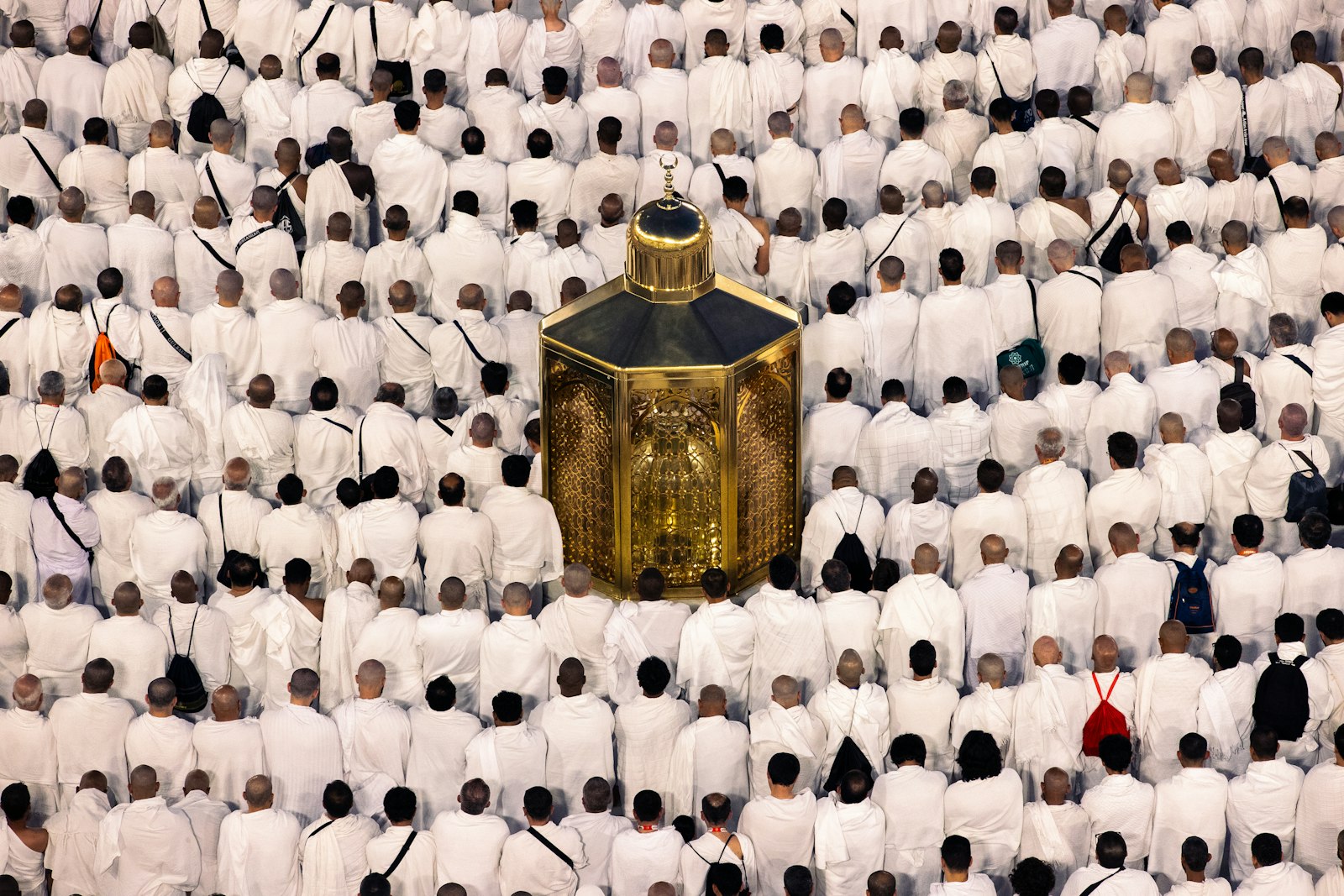
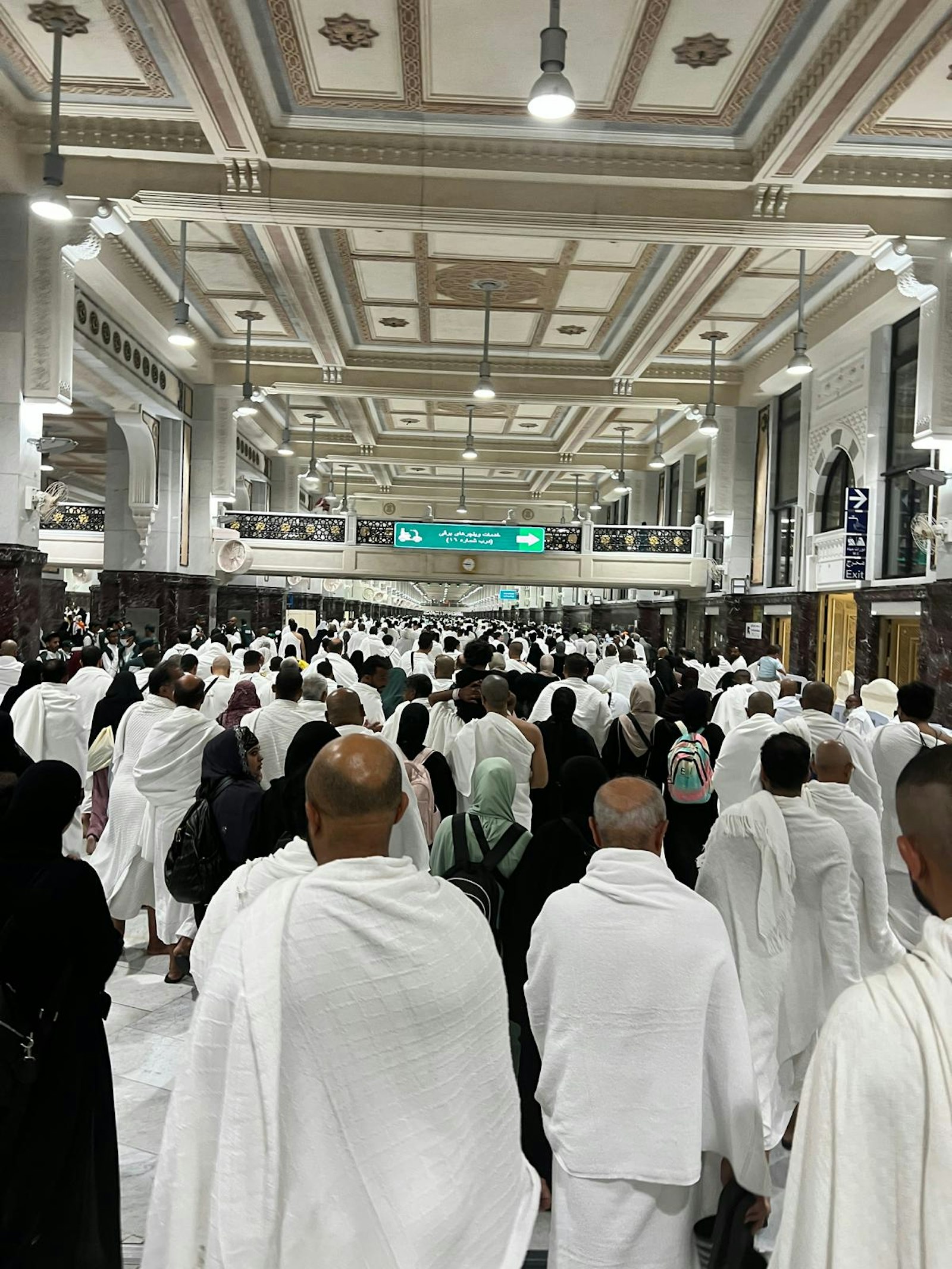
Men: wear two unstitched white sheets (Izar + Rida’); head must remain uncovered
Women: wear loose, full-coverage modest clothing; face and hands remain uncovered (no Niqab or gloves in Ihram)
Make Niyyah (intention) in the heart for Umrah — no specific verbal formula required
Begin reciting the Talbiyah.
The Talbiyah
لَبَّيْكَ اللَّهُمَّ لَبَّيْكَ، لَبَّيْكَ لَا شَرِيكَ لَكَ لَبَّيْكَ، إِنَّ الْحَمْدَ وَالنِّعْمَةَ لَكَ وَالْمُلْكَ، لَا شَرِيكَ لَكَLabbaik Allahumma labbaik. Labbaik la sharika laka labbaik. Innal-hamda wan-ni'mata laka wal-mulk, la sharika lak.I am here at Your service, O Allah, I am here at Your service. I am here at Your service, You have no partner, I am here at Your service. Surely the praise, and blessings are Yours, and the dominion. You have no partner.
Agreed upon by Muslim, Bukhari, Abi Dawud and others.
Pro Tip
Flying into Jeddah from your country? Your aircraft crosses the Al-Juhfah Miqat alignment approximately 45 minutes before landing. Wear your Ihram before boarding — do not plan to change in the aircraft toilets. Jeddah is inside the Miqat boundary; you cannot assume Ihram on the ground.
Step 2: Entering Masjid al-Haram and the Arrival Dua
When any one of you enters the mosque, he should say:"Allahumma iftah li abwaba rahmatik" ; and when he steps out he should say: "Allahumma inni as'aluka min fadlik".
Sahih Muslim 713a
Enter Masjid al-Haram with your right foot first, reciting the entry supplication. Stop reciting the Talbiyah as you enter the mosque and prepare for Tawaf.
Enter with the right foot and recite the masjid entry dua
Stop the Talbiyah — it is no longer recited once you begin Tawaf
Proceed directly to the Mataf (Tawaf area) to begin your first circuit
Step 3: Tawaf al-Umrah — The Seven Circuits of the Ka'bah
Aisha said, "The first thing the Prophet (saw) did on reaching Makkah, was the wudu and then he performed Tawaf of the Kaaba"
-Sahih al-Bukhari 1614
Tawaf must be performed with Wudu. You will circumambulate the Ka‘bah seven times anticlockwise, beginning and ending each circuit at the Black Stone (al-Hajar al-Aswad). Before you begin: confirm you are in a state of Wudu. If Wudu breaks during any circuit, exit the Mataf, renew Wudu, and resume from the point you left off — you do not restart the full seven circuits.
Face the Black Stone and make your intention for Tawaf
Raise your right hand toward the Black Stone, say “Allahu Akbar”, and begin circuit 1
Men: perform Idtiba (uncover the right shoulder by passing the Rida’ under the right armpit) - Sunnah
Men: perform Ramal (walk briskly with short, quick steps) in circuits 1–3; walk normally in circuits 4–7 - Sunnah
Touch the Yemeni Corner (Rukn al-Yamani) with the right hand each time you pass — do not kiss it
Between the Yemeni Corner and the Black Stone: recite “Rabbana atina fid-dunya hasanah...” (Sunan Abi Dawud 1892)
At the Black Stone at the start of each new circuit: say “Allahu Akbar”, point or touch if accessible without pushing
Complete 7 full circuits — ending at the Black Stone
Pro Tip
Only the Black Stone and the Yemeni Corner should be touched.
If you can reach the Yemeni Corner without crowding or harming others, touch it with the right hand — do not kiss it and do not gesture from a distance if you cannot reach it.
Do not touch the Kaaba walls or the two corners facing Syria and Iraq — this is a common mistake with no basis in the Sunnah (Sahih al-Bukhari 1609).
If you cannot reach the Black Stone, a gesture from a distance is fully valid — never push or jostle others.
Step 4: Maqam Ibrahim and the Two Rak‘ahs of Tawaf
"The Prophet (saw) arrived at Makkah and performed Tawaf of the Kaaba and then offered a two-rak'ah prayer..."
Sahih al-Bukhari 1647
Immediately after completing the seventh circuit, proceed to Maqam Ibrahim (the Station of Ibrahim) to pray two Rak‘ahs.
Cover the right shoulder (replace Idtiba) before praying — Idtiba is for Tawaf only
Pray two Rak‘ahs behind Maqam Ibrahim — if the area is crowded, anywhere in the Haram is valid
After the prayer, go to the Zamzam taps and drink your fill
Pro Tip
The two Rak‘ahs of Tawaf are Wajib or Sunnah according to many scholars — do not leave the Haram before performing them. If a congregational prayer begins while you are mid-Tawaf, join the prayer and resume your circuits from where you left off afterwards.
Step 5: Sa‘i (Walking Seven Times Between Safa and Marwa)
Indeed, ˹the hills of˺ Ṣafa and Marwah are among the symbols of Allah. So whoever makes the major or minor pilgrimage to the ˹Sacred˺ House, let them walk between ˹the two hills˺. And whoever does good willingly, Allah is truly Appreciative, All-Knowing.
Surah Al-Bakarah - Ayat 158
Sa‘i does not require Wudu, though it is recommended to maintain it. Proceed from the Zamzam area toward the Mas‘a corridor.
On approaching Safa for the first time, recite: “Innas-Safa wal-Marwata min sha‘a’irillah...” from Surah al-Bakarah (Sahih Muslim 1218a) — this recitation is only for the first approach
Ascend Safa, face the Qibla, raise your hands and make du‘a
Walk to Marwa — this counts as lap 1
Men: jog lightly between the two green-lit markers in the Sa‘i corridor; walk normally outside the markers
Women: walk normally throughout all 7 laps — no jogging required
On Marwa: face the Qibla, raise your hands, make du‘a — this completes lap 1
Continue: Marwa to Safa = lap 2, and so on. The 7th lap ends at Marwa.
Total: 7 laps — beginning at Safa, ending at Marwa
Pro Tip
For a smoother and less congested experience, head to the 2nd or 3rd floor to perform your Sa'i. The ground level gets extremely crowded and heavily trafficked, whereas the upper floors offer more breathing room, better airflow, and a steady walking pace.
Step 6: Tahallul (Shaving or Cutting Hair) and Completion
The Messenger of Allah (saw) said: "O Allah! Be merciful to those who have their head shaved." The people said, "O Allah's Messenger! And (invoke Allah for) those who get their hair cut short." The Prophet said, "O Allah! Be merciful to those who have their head shaved." The people said, "O Allah's Messenger! And those who get their hair cut short." The Prophet said (the third time), "And to those who get their hair cut short."
Sahih al-Bukhari 1727
The Prophet (saw) said: "Shaving is not a duty laid on women; only clipping the hair is incumbent on them."
Sunan Abi Dawud 1985
Tahallul is the final Pillar of Umrah. It must be performed after Sa‘i. Once done, all Ihram prohibitions are lifted.
Men — Halq (preferred): shave the entire head. Barber services are widely available immediately outside the Haram and in the hotel district.
Men — Taqsir (valid): trim a finger’s width of hair from all areas of the head uniformly — not just a single lock from one side.
Women — Taqsir only: gather the hair and cut approximately a fingertip’s length (2–3 cm) from the ends. No barber required; done privately.
Once Tahallul is complete: all Ihram prohibitions are lifted — sewn clothing, perfume, and marital relations are once again permissible.
Pro Tip
For Women: Make sure to pack a small pair of scissors in your checked luggage. To exit Ihram, you only need to cut about 1.5–2 cm (roughly a fingertip's length) from the ends of your hair. Having your own scissors saves you the hassle of trying to borrow them in public areas.
For Men: Always carry cash with you. While there are free mobile/street haircutting services available, they are usually extremely crowded. To save time and avoid long lines, you will likely need to use a paid barber, and most of them only accept cash payments.
What Invalidates Your Rituals?
The difference between a Pillar error and a Wajib breach determines whether your Umrah is invalid or simply requires a Fidyah (penalty). The table below covers the most common errors pilgrims encounter.
Error
What it means
Consequence
Tawaf without Wudu
Tawaf requires ritual purity throughout. If Wudu breaks mid-circuit, exit, renew, and resume — do not restart.
Pillar invalidated; that circuit does not count
Tawaf fewer than 7 complete circuits
Each circuit must begin and end at the Black Stone. A partial circuit does not count.
Pillar invalidated; Tawaf must be completed
Tawaf performed clockwise
Tawaf must be performed anticlockwise with the Ka‘bah on the left. Clockwise circuits are invalid.
Pillar invalidated; circuits must be repeated anticlockwise
Sa‘i fewer than 7 laps
Safa to Marwa = 1; Marwa to Safa = 2. The 7th lap must end at Marwa. Stopping at 6 laps is invalid.
Pillar invalidated; remaining laps must be completed
Sa‘i not starting at Safa
Sa‘i must begin at Safa. Starting from Marwa reverses the direction and invalidates the count.
Pillar invalidated; Sa‘i must restart from Safa
Skipping Tahallul entirely
Exiting Ihram without Halq or Taqsir means the Umrah is incomplete. All Ihram prohibitions remain in force.
Pillar incomplete; Umrah not concluded
Crossing Miqat without Ihram
A Wajib breach — not a Pillar omission. Umrah remains valid but Dam (penalty) is required.
Dam required; Umrah remains valid
Keeping Idtiba on during prayer at Maqam Ibrahim
Idtiba applies during Tawaf only. The right shoulder must be covered before praying.
No effect on Umrah validity; Sunnah neglected
Penalties for the Rituals of Umrah
"Complete the pilgrimage and minor pilgrimage for Allah. But if prevented ˹from proceeding˺, then ˹offer˺ whatever sacrificial animals you can afford. And do not shave your heads until the sacrificial animal reaches its destination. But if any of you is ill or has a scalp ailment ˹requiring shaving˺, then compensate either by fasting, charity, or a sacrificial offering. In times of peace, you may combine the pilgrimage and minor pilgrimage then make the sacrificial offering you can afford. Whoever cannot afford that ˹offering˺, let them fast three days during pilgrimage and seven after returning ˹home˺—completing ten. These offerings are for those who do not live near the Sacred House. And be mindful of Allah, and know that Allah is severe in punishment."
Surah Al-Bakarah - Ayat 196
Umrah penalties fall into three distinct categories depending on the nature of the breach: violations of Ihram prohibitions that carry a Fidyah (penalty offering), breaches of Wajibat (mandatory acts) that require Dam, and acts so severe they invalidate the Umrah entirely. Understanding which category applies to an error determines the correct remedy.
Violation category
Examples
Penalty (Fidyah / Dam)
Umrah validity
Fidyah of Choice (Fidyah al-Adha)
Using perfume, shaving or cutting hair before Tahallul, men wearing sewn/fitted clothing, and men covering the head
Choose ONE of three: fast for 3 days; feed 6 poor people (approx. 1.5 kg food per person); or sacrifice a sheep in Makkah
Remains valid
Wajib breach (Dam)
Crossing the Miqat without Ihram; omitting the two Rak‘ahs of Tawaf
Sacrifice a sheep (Dam) in Makkah; arranged through a trusted local agent or authorised channel
Remains valid
Hunting land animals
Killing or hunting any land animal while in Ihram
Sacrifice an equivalent domestic animal, or feed the poor with its monetary value (Quran 5:95)
Remains valid
Marriage contract during Ihram
Contracting, conducting, or proposing marriage while in Ihram
The contract is void. No Fidyah required; repentance and re-contracting after Ihram is lifted (Sahih Muslim 1409)
Remains valid
Marital relations before completion
The most severe prohibition. Applies if committed before all four Pillars are completed.
Must still complete the invalidated rituals; sacrifice a camel or sheep; perform a full Qada’ (make-up) Umrah as soon as possible
Invalidated — Qada’ required
The Fidyah of Choice: Three Equal Options
When a pilgrim violates an Ihram prohibition under necessity — illness, injury, or genuine hardship — the penalty is a choice between three equal forms of Fidyah (compensation). No one option is superior in validity; the choice belongs to the pilgrim. Ka‘b bin ‘Ujrah (RA) was given this ruling directly by the Prophet when lice fell from his head due to illness on the journey to Makkah (Sahih al-Bukhari 1814):
Fast
Three days of fasting
Feed
Feed six poor people (half a Sa‘ per person — approximately 1.5 kg of food each)
Sacrifice
Arrange sheep sacrifice in Makkah via a verified channel or your hotel
Pro Tip
If you commit a violation unintentionally or under necessity, there is no sin — only the penalty. Do not allow anxiety about a mistake to distract you from the rest of your Umrah. Complete all remaining rituals first, then arrange the penalty calmly. Your hotel concierge or the Haram’s guidance offices can direct you to authorised channels for sacrifice arrangements in Makkah or you can fulfill this obligation easily and securely online through the official Adahi Project platform.
Frequently Asked Questions
Quick answers about the main pillars of Umrah
Where exactly should I start my first circuit of Tawaf?
Start at the Black Stone (al-Hajar al-Aswad), which is set into the south-eastern corner of the Ka‘bah. Face the Black Stone, raise your right hand toward it, say “Allahu Akbar”, and begin walking anticlockwise with the Ka‘bah on your left. A green floor marker in the Mataf indicates the Black Stone’s level — each time you return to this line, you have completed one full circuit.
Do I need to perform a new Niyyah (intention) for each circuit?
No. A single Niyyah at the start of Tawaf covers all seven circuits. The intention is made in the heart and does not need to be repeated for each round. The Talbiyah, which you stop reciting when you enter the Haram for Tawaf, is also not repeated between circuits.
What are the specific rules for Idtiba (exposing the shoulder) for men?
Idtiba is performed by placing the Rida’ (upper Ihram sheet) under the right armpit and draping it over the left shoulder, leaving the right shoulder and upper arm uncovered. It applies only during the seven circuits of Tawaf. Once the seventh circuit is complete, cover the right shoulder before praying the two Rak‘ahs at Maqam Ibrahim — praying with the shoulder exposed is contrary to the Sunnah. Idtiba is not required during Sa‘i.
Can I take a break between Tawaf and Sa‘i?
Yes. There is no obligation to proceed immediately from Tawaf to Sa‘i. You may sit, drink Zamzam, pray the two Rak‘ahs of Tawaf, or rest before beginning Sa‘i. Sa‘i should follow Tawaf in the same sitting where possible, but a gap does not invalidate either ritual. If a congregational prayer begins, join it and begin Sa‘i afterwards.
How much hair must a woman cut to complete the ritual?
A woman should gather her hair and cut approximately a fingertip’s length (roughly 2-3 cm) from the ends. The cut should be from all the hair, not just a single strand. There is no need for a barber — this is done privately. Shaving the head is not prescribed for women under any circumstances; Taqsir is the only valid form of Tahallul for women.
How do I perform Dam if I made a mistake during my Umrah?
Yes — Dam is required if you intentionally or forgetfully missed a Wajib act of Umrah, such as entering Ihram from the wrong place, leaving before performing the two Rak'ahs of Tawaf, or failing to shave or trim your hair before exiting Ihram. Dam means sacrificing a sheep or goat within the Haram boundary of Makkah, with the meat distributed to the poor of the Haram. The Saudi government has made this straightforward for DIY pilgrims through the Adahi Project (Saudi Project for the Utilisation of Hajj and Umrah Sacrifices), operated by the Islamic Development Bank.
Your pilgrimage in the safest hands online
The world's #1 halal-friendly booking platform. Officially aligned with Saudi authorities, airline and lifestyle rewards programmes.
Airline Miles & Travel Rewards Partners
Download the Halalbooking app!
Planning halal-friendly trips is even easier with our app. Scan the QR code with your phone camera to download it.
4.8
4.7
Ready to Start Your Umrah Journey?
Book your accommodation with confidence. Refundable options available.
Both male and female guests of the property can use the facility at the same time
Ladies-only
Only female guests of the property can use the facility
Men-only
Only male guests of the property can use the facility
Private-hire
The facility can be hired for a period of time for a private use of one guest/family
Alcohol-free restaurant
No alcohol is served in at least one restaurant in the property. Alcohol is served in the rest of the property
Halal food nearby
Halal food is available in restaurants/cafes/grocery shops within 500m of the property
Alcohol-free room
Alcohol can be removed from the room if requested as a Stay request during the booking process on Halalbooking. Alcohol is served in the rest of the property
All halal food
All food in the property is always halal
Some halal food
Some food in the property is always halal
Halal food on request
Halal food in the property is available if requested in advance
Alcohol-free property
No alcohol is served anywhere in the property
Bidet amenities
Property has bidet amenities in all/some room bathrooms (e.g. handheld bidet spray, standalone bidet, toilet with bidet nozzle, or smart toilet with bidet).
Smart toilet with bidet
Electronic toilet with built-in bidet functionality, controlled via panel or remote. Common in Japan and often referred to as a washlet, such as "Toto Washlet".
Toilet with bidet nozzle
Toilet with a built-in, manually operated water nozzle. Common in Turkiye, where it is known as "taharet musluğu".
Standalone bidet
Separate ceramic bidet fixture installed next to the toilet.
Handheld bidet spray
Handheld water spray installed next to the toilet. Also known as shattaf, bidet hose or hygiene hose.
Breakfast Included
Breakfast included in the price
Room Only
Only accommodation included in the price
Self-catering
Only accommodation included in the price, there is a kitchen to store and prepare your personal food
Ramadan Suhur & Iftar
Suhur & Iftar included in the price
Half Board
Breakfast & dinner included in the price
Full Board
Breakfast, lunch & dinner included in the price
All Inclusive
Meals and drinks throughout the day are included in the price
Kaaba view rooms
These are rooms on the higher floors of the hotel offering a direct view of the Kaaba itself, located in the centre of the Masjid al-Haram in Makkah. In addition to the Kaaba you will also see the yard around the holy mosque and its minarets, gates and walls.
Haram view rooms
These rooms offer a view of the Masjid al-Haram.
In Makkah, you will be able to see the yard around the holy mosque, the minarets, gates and the walls of the mosque but not the Kaaba itself. To see the Kaaba you need to select Kaaba view rooms.
Haram-connected prayer hall
Prayer hall in the hotel, from which you can see the imam, or rows of the congregation praying directly behind the imam, leading the prayer in the Masjid al-Haram in Makkah, and which is connected to the Masjid al-Haram's sound system. This means you can actually pray in the same jamaat as in the Masjid al-Haram in Makkah whilst you are in the hotel's prayer hall.
Free shuttle to Haram
Free shuttle service operates between the hotel and the Masjid al-Haram.
Haram in walking distance
The hotel is within walking distance of the nearest gate of the Masjid al-Haram. 'Walking distance' means maximum 20 minutes/1,300 metres' walk.
Bookable airport transfer
Driver meets you personally outside the terminal
Why you can trust our reviews
Only verified guests who booked and stayed can review. We use only recent reviews (under 12 months) for properties with 30+ reviews.
...
Our score
Rated by customers of Halalbooking, most of whom are halal-conscious travellers.
...
External score
Rated by customers of mainstream travel websites, many of whom might not be halal-conscious travellers.
For properties which have enough recent reviews from our customers, we show Our score, otherwise we show the External score.
Why you can trust our reviews
Only verified guests who booked and stayed can review. We use only recent reviews (under 12 months) for properties with 30+ reviews.
...
Our score
Rated by customers of Halalbooking, most of whom are halal-conscious travellers.
...
External score
Rated by customers of mainstream travel websites, many of whom might not be halal-conscious travellers.
For properties which have enough recent reviews from our customers, we show Our score, otherwise we show the External score.
HB GLOSSARY
Alone
Age for a guest to be allowed into the facility alone
Accompanied
Age for a guest to be allowed into the facility if accompanied by an adult
Boys
Age for a boy guest to be allowed into the ladies-only facility
Girls
Age for a girl guest to be allowed into the men-only facility
Modest swimwear compulsory
Age for a guest when wearing modest swimwear is compulsory in the mixed-gender facility
In villa/room
The facility is for exclusive private use of the guest/family who is staying at the specific villa/room
No staff allowed
No staff is allowed in the facility without the guest’s permission
Only female staff
Only female staff is allowed in the facility without the guest’s permission
Male and female staff
Both male and female staff is allowed in the facility without the guest's permission
Fully-secluded
100% privacy from an outside eye in all parts of the facility
Mostly-secluded
100% privacy from an outside eye in most parts of the facility
Part-secluded
100% privacy from an outside eye in a part of the facility
Non-secluded
No privacy from an outside eye in the facility
Secluded
100% privacy from an outside eye in all parts or most parts or just a part of the facility
Modest swimwear compulsory
Modest swimwear is compulsory in this facility. Standard swimwear is not allowed
Modest swimwear: made from proper swimwear material and covers most of body for ladies and upper legs for men (e.g. semi-covered burkini, fully-covered burkini, Muslim swimsuit, long swimming shorts)
Standard swimwear: more revealing swimwear (e.g. one-piece swimsuit, tankini, bikini, short swim trunks or speedos)
Modest swimwear mostly observed
Modest swimwear is observed by most guests in this facility, but standard swimwear is allowed too
Modest swimwear: made from proper swimwear material and covers most of body for ladies and upper legs for men (e.g. semi-covered burkini, fully-covered burkini, Muslim swimsuit, long swimming shorts)
Standard swimwear: more revealing swimwear (e.g. one-piece swimsuit, tankini, bikini, short swim trunks or speedos)
Modest swimwear not allowed
Modest swimwear is not allowed in this facility, only standard swimwear is allowed
Modest swimwear: made from proper swimwear material and covers most of body for ladies and upper legs for men (e.g. semi-covered burkini, fully-covered burkini, Muslim swimsuit, long swimming shorts)
Standard swimwear: more revealing swimwear (e.g. one-piece swimsuit, tankini, bikini, short swim trunks or speedos)
Swimwear compulsory
Swimwear is compulsory in this facility. Nudity is not allowed
Swimwear mostly observed
Swimwear is observed by most guests in this facility, but nudity is allowed too
Swimwear optional
Swimwear is optional in this facility. Nudity is allowed
Swimwear not allowed
Swimwear is not allowed in this facility. Nudity is observed by most guests, but you personally may cover your body with a towel
Modest swimwear allowed
Modest swimwear is allowed in this facility. Most guests observe standard swimwear
Modest swimwear: made from proper swimwear material and covers most of body for ladies and upper legs for men (e.g. semi-covered burkini, fully-covered burkini, Muslim swimsuit, long swimming shorts)
Standard swimwear: more revealing swimwear (e.g. one-piece swimsuit, tankini, bikini, short swim trunks or speedos)
Modest swimwear
Modest swimwear is either compulsory or observed by most guests or simply allowed (with most guests observing standard swimwear) in this facility
Modest swimwear: made from proper swimwear material and covers most of body for ladies and upper legs for men (e.g. semi-covered burkini, fully-covered burkini, Muslim swimsuit, long swimming shorts)
Standard swimwear: more revealing swimwear (e.g. one-piece swimsuit, tankini, bikini, short swim trunks or speedos)
We Price Match
Enjoy peace of mind with our Price Match offer. Found a better price? Let us know and we’ll try to match it. Our average response time is 12 hours.
Instant confirmation
Booking is confirmed immediately after it is submitted
24h confirmation
Once you have submitted a booking request, the property owner/manager has 24 hours to accept or decline your request. The booking is not confirmed until you've received a booking confirmation email from us.
Private-use
The facility is for exclusive private use of the guest/family who is staying at the specific villa/room
In all rooms
The facility is for exclusive private use of the guest/family who is staying at the villa/room
In all villas
The facility is for exclusive private use of the guest/family who is staying at the villa/room
In some rooms
The facility is for exclusive private use of the guest/family who is staying at the specific villa/room
In some villas
The facility is for exclusive private use of the guest/family who is staying at the specific villa/room
Why groups instead of rooms?
When searching for a family, include all guests into the same group. Our system will offer to book either 1 large room which is suitable or 2+ smaller rooms when needed with connection or adjacency where possible. Sometimes multiple smaller rooms are a better deal than 1 large room.
Only when searching for multiple families that must stay in separate rooms, enter each family as a separate group.
Strict
Age restriction is a strict rule and flexibility will not be provided
Guidance
Age restriction is for guidance only and final decision will be at the discretion of the hotel's management
South-facing
The room view is facing south. When you perform your prayers in your room you face towards Al-Masjid an-Nabawi as the Kaaba (Mecca) is also in the south. This means Al-Masjid an-Nabawi is in front of you during your prayers.
East-facing
The room view is facing east. When you perform your prayers in your room you face sideways to Al-Masjid an-Nabawi as the Kaaba (Mecca) is in the south. This means Al-Masjid an-Nabawi is on your left side during your prayers.
For rooms where Al-Masjid an-Nabawi is in front of you during your prayers, please choose a hotel with “south-facing” rooms.
North-facing
The room view is facing north. When you perform your prayers in your room you face away from Al-Masjid an-Nabawi as the Kaaba (Mecca) is in the south. This means Al-Masjid an-Nabawi is behind you during your prayers.
For rooms where Al-Masjid an-Nabawi is in front of you during your prayers, please choose a hotel with “south-facing” rooms.
Men's section
The walking distance from the hotel to the nearest gate of the men's section of the Masjid al-Haram.
Ladies' section
The walking distance from the hotel to the nearest gate of the ladies section of the Masjid al-Haram.
Haram not in walking distance
The hotel is not within walking distance of the Masjid al-Haram. 'Walking distance' means maximum 20 minutes/1,300 metres' walk.
Free shuttle
Free shuttle service operates between the hotel and the Masjid al-Haram.
No free shuttle
No free shuttle service operates between the hotel and the Masjid al-Haram.
Walking time from drop-off to Haram
Walking time from the drop-off point to the Masjid al-Haram can roughly double during peak prayer times and Ramadan due to heavy foot traffic.
Shuttle time
The time the shuttle takes between the hotel and the drop-off point. Where two numbers are shown, the lower is with no traffic and the higher allows for heavy traffic.
Ajyad Station
Short, 8-minute walk to King Abdulaziz Gate via southern Ajyad Street beside the Clock Tower—the same walking time as Rea Bakhsh and King's Gate stations.
Rea Bakhsh Station
Short, 8-minute walk to King Abdulaziz Gate via southern Ajyad Street beside the Clock Tower—the same walking time as Ajyad and King's Gate stations.
Shaib Amir Station
Medium, 10-minute walk to Al Fath Gate on the north-east side—2 minutes longer than the southern stations, but 2 minutes shorter than Jarwal.
King's Gate Station
Short, 8-minute walk to King Abdulaziz Gate: walk underneath the Clock Tower and take the escalator upstairs—the same walking time as Ajyad and Rea Bakhsh stations.
Jarwal Station
Medium, 12-minute walk to King Abdullah Gate on the north-west side—4 minutes longer than the southern stations and 2 minutes longer than Shaib Amir and Al Ghaza.
Conrad Jabal Omar Makkah
Very short, 3-minute walk to King Fahd Gate via Ibrahim Al Khalil Road—the second-closest drop-off, only 1 minute longer than InterContinental and 5 minutes shorter than the southern stations.
Al Ghaza Station
Medium, 10-minute walk to Al Fath Gate on the north-east side—the same walking time as Shaib Amir, 2 minutes longer than the southern stations and 2 minutes shorter than Jarwal.
InterContinental Dar al Tawhid
Shortest walk of all drop-offs: 2 minutes to King Fahd Gate via Ibrahim Al Khalil Road—1 minute shorter than Conrad and 6 minutes shorter than the southern stations.
Bab Ali Station
Short, 5-minute walk to Ali Gate on the eastern side—one of the nearest drop-offs and the closest of the shuttle stations, 2 minutes longer than Conrad and 3 minutes shorter than the southern stations.
King's Gate Station via Kudai Car Park
Two-stage journey: the hotel shuttle drops guests at Kudai Car Park, where they transfer to a free government shuttle to King's Gate Station by the Clock Tower near the Haram, followed by a short, 8-minute walk to King Abdulaziz Gate—the same final walk as Ajyad and Rea Bakhsh stations, but with one additional shuttle transfer.
Ajyad Street
Short surface-street route rather than a tunnel: traffic-dependent and slower than the tunnel routes at prayer times and in Ramadan.
Al Kidwah Tunnel
One of the shortest tunnel routes, coming in from the south past the Clock Tower. More traffic-protected and much steadier at prayer times than the surface-road routes.
Al Jamarat Tunnel
Longer than the central Ajyad and Al Kidwah tunnels because it starts from the Al Jamarat and Jarwal side, but steadier than the surface-road routes; only the short street sections at either end are traffic-sensitive.
Mahbas Al Jinn Tunnel
Longer tunnel route from the Mahbas Al Jinn and Aziziah side: it starts further out than the central tunnels, but is traffic-protected and steadier than the road routes.
Maskhoutah Tunnel
One of the longest tunnel routes, from the eastern side of Makkah: it starts well out from the Haram, but is less exposed to traffic than the main-road routes.
Masfalah Tunnel
Short, tunnelled ride from the Masfalah side - closer in than the eastern tunnels and less exposed to street traffic than the road routes.
Kudai Tunnel
Medium-length tunnel route from the Kudai and Ajyad side: longer than the central Ajyad and Al Kidwah tunnels, but shielded from street traffic for most of the way and therefore much steadier than the road routes.
Al Khindama Road
Surface-road approach rather than a tunnel: shorter than the outer eastern routes, but far more traffic-sensitive than any tunnel route, with local access restrictions adding further variation through the day.
Jabal Omar Internal Road
Among the shortest and most consistent routes: an internal journey through the Jabal Omar complex to a Haram-facing drop-off, with no exposure to public-road traffic.
Aziziah Road
Main roads the whole way from Aziziah: the most traffic-exposed of the routes, and the most likely to run to the top of its journey-time range at prayer times.
Al Taqwa Street
Fairly short surface route from the Al Hijrah side, south of the Haram, when clear: fully exposed to traffic and local restrictions, so the ride can take more than twice as long at busy times.
King Faisal Road
Longer surface-road route forming the main eastern approach from the Al Maabdah and Al Shara’i side: with no tunnel protection, traffic and access controls can extend the ride near the Haram.
Al Masjid Al Haram Road
Main surface road along the Al Maabdah and Shaib Amir approach to the Haram: direct but traffic-exposed, and one of the road routes most likely to lengthen at peak times.
Al Taysir Road
Short surface-road route from Al Taysir and Jarwal to Jarwal Station, close to the Haram. Usually one of the quickest road approaches, though traffic and access controls can still add time at peak periods.
Ajyad Tunnel
Very short tunnel route through the Ajyad section of the First Ring Road, close to the Haram and King's Gate Station. Shielded from surface traffic for most of the ride, so journey times stay very steady.
Ibrahim Al Khalil Road
Short, direct surface-road approach for the central hotels from the Masfalah side to the western edge of the Haram: with no tunnel protection, traffic and prayer-time access restrictions can affect the ride.
Adjacency possible
Rooms can be allocated adjacent to or opposite each other, but cannot be made interconnected. Not guaranteed and subject to availability.
Connection possible
Rooms can be made interconnected by unlocking an internal door between the rooms. Not guaranteed and subject to availability.
One room for all guests
One room to fit your entire group
None possible
Rooms can neither be adjacent to nor opposite each other nor be made interconnected
Price view mode
Choose which prices are shown on the price tags in search results and property screens. 'Show Guest and Agency Prices' shows guest total prices as well as agency net prices and commission. 'Show only Guest Prices' displays only guest total prices, and 'Show only Agency Prices' presents only your agency net prices and commission. The selection doesn't influence the final price to pay (Agency net price).
Additional beds might be available for a fee
Guests are expected to use only the included beds. Additional beds might be available at the property for a fee, which is usually indicated in the Important Notes section.