

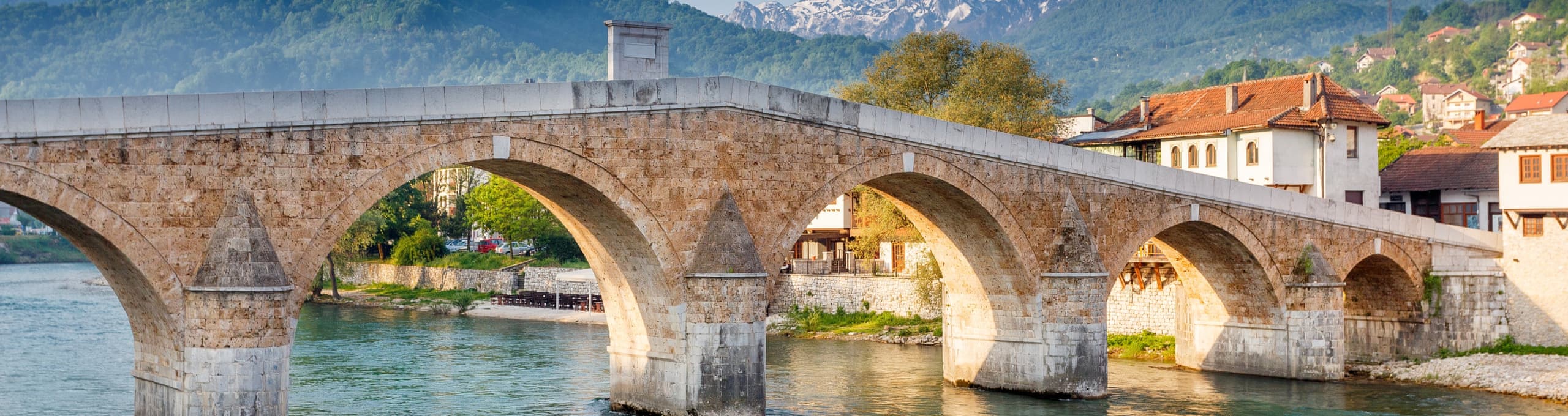
BOSNIA-HERZEGOVINA Halal-friendly vacations

Bosnia-Herzegovina Halal-friendly vacations general information
Halalbooking guide to halal-friendly vacations in Bosnia and Herzegovina
Over 50% of Bosnia and Herzegovina’s 3.5 million population is Muslim. This makes it an extremely convenient place for Muslims to visit on vacation. It is easy to find halal food, you will have the opportunity to worship in historic mosques and above all the local people are extremely friendly and welcoming.
The currency in Bosnia and Herzegovina is the Bosnian Mark. Generally exchange rates are favorable and vacations here are extremely good value for money.
Top reasons for Muslims to visit Bosnia and Herzegovina
- Beautiful Natural Landscape
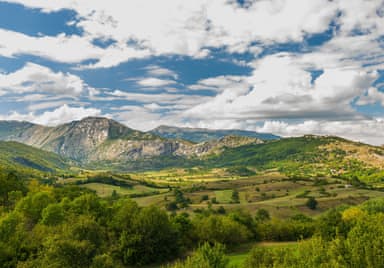
The lush green mountain scenery of Bosnia and Herzegovina is extremely beautiful. It is the setting for cascading waterfalls and picturesque medieval castles. Wherever you stay on your halal-friendly vacation, you should definitely make time to go out and explore the countryside. Don’t miss the impressive Kravice Waterfalls, which tumble some 25 meters down the rock face, and are easily reached from Mostar and the dramatic double cascade of the Strbacki Buk Waterfalls, close to Bihac.
- Fascinating History
The area where Bosnia and Herzegovina is situated today has been inhabited since Neolithic times. It was part of the Western Roman Empire and then ruled by Germanic tribes, Slavs and Hungarians before being proclaimed a kingdom in 1377. In 1463 it was conquered by the Ottoman Empire, and remained part of it until 1878 when the Ottomans ceded it to Austria-Hungary. It was during this period that many of its inhabitants converted to Islam.
In 1929 it became part of the Kingdom of Yugoslavia. In 1941 Bosnia-Herzegovina was annexed by pro-Hitler Croatia and liberated in 1945, after which time it became part of the Socialist Federal Republic of Yugoslavia. In March 1992, following the fall of Communism, Bosnia and Herzegovina became an independent state. Later that same month, however, war broke out between the different ethnic groups: Serbs, Croats and Muslim Bosnians. In 1995, hostilities ended and a period of reconciliation and rebuilding followed. In 2016 Bosnia and Herzegovina submitted its formal application to join the EU.
The recent history of Bosnia and Herzegovina and the genocide of the Muslim Bosnians
Bosnia and Herzegovina has a history of conflict. It was in Sarajevo where the Archduke Franz Ferdinand of Austria and his wife, Sophie, were assassinated by a Bosnian Serb nationalist in 1914, triggering the start of the First World War.
In more recent years, Bosnia Herzegovina was at the heart of the Yugoslav Wars, which followed the fall of Communism and the break-up of Yugoslavia. During this period, divisions between ethnic Serbs, Croats and Bosnians escalated, resulting in the ethnic cleansing of Muslim Bosnians and damage to many mosques. Of the many atrocities committed during this period, perhaps the worst was the Massacre of Srebrenica in 1995, an act of genocide, when more than 8,000 Muslim Bosnian men and boys were killed at the hands of the Bosnian Serb Army.
- Top historic sites for Muslims to visit
Stari Most and the old town of Mostar
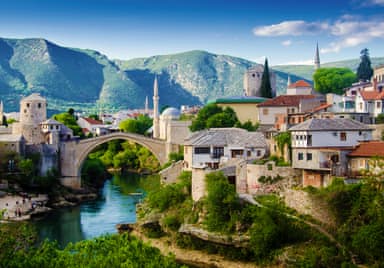
In 1566 a stone bridge was built across the Neretva River, by the Ottoman architect Mimar Hajruddin, to a design prepared by the great architect, Mimar Sinan and was a powerful symbol of multiculturalism and ethnic tolerance. The town was well known for its old Ottoman houses and its Austro-Hungarian architecture from the 19th and 20th centuries. In 1993 the old bridge was destroyed under shelling by Croat forces. After the conflict, it was decided that the bridge should be rebuilt as a symbol of reconciliation. It was re-built using the same local materials and Ottoman construction techniques which the original Turkish architects employed nearly 500 years ago. The reconstruction was carried out by an expert Turkish company specialized in the renovation and reconstruction of historical monuments from the Ottoman era utilizing some of the original stone recovered from the river bed. Stari Most was reopened in 2004.
Kajitas House, Mostar
This half-timbered Ottoman house, in the old town of Mostar, was originally the harem of a much larger house built in the 16th century for a Turkish judge. It is full of original artifacts and is still owned by the descendants of its original owners.
The Tunnel Museum, Sarajevo
This museum is a terrible but timely reminder of the period from 1992-1995 when Sarajevo was under siege by hostile Serb forces. The hand-dug tunnel was the only way to enter and exit the city.
Grave of Alija Izetbegović in the Kovači War Memorial and Cemetery
The Kovači War Memorial and Cemetery is the main cemetery for soldiers from the Bosnian Army who were killed during the siege of Sarajevo. It is also known for the grave of Alija Izetbegović, the first President of the Yugoslav Republic of Bosnia and Herzegovina who requested to be buried among the martyrs. Many Muslims choose to pay their respects to the “Wise King of Bosnia Herzegovina” also widely referred as “father” and pray here at the Martyrs’ Memorial Cemetery for the victims who died in this senseless war.
Srebrenica Potocari Genocide Memorial
This moving memorial cemetery is the place to pay your respects to the victims at the site of the 1995 Massacre of Srebrenica. The cemetery is dedicated to the 8,372 Srebrenica civilians murdered by members of the Serbian Army from July 11-16, 1995 during the Bosnian War. It is situated in Eastern Bosnia around 10kms from the border with Serbia and is easily reached on a day trip from Sarajevo.
- Friendly, Welcoming People
A large proportion of the overseas visitors who come to Bosnia and Herzegovina on vacation are from predominantly Muslim countries such as Turkey, Qatar and Bahrain. The local people are very hospitable and have an especially warm welcome for their Muslim visitors. Since the majority of the population is Muslim they also have a good understanding of the needs of Muslim guests and their halal requirements.
Top destinations for a halal vacation in Bosnia and Herzegovina
This fascinating city is the capital of Bosnia and Herzegovina, offering a rich blend of eastern and western influences. It boasts a diverse historic heritage with majestic buildings dating from its Ottoman, Austro-Hungarian and Yugoslavian past. You will enjoy exploring the Old Town of Bascarsija with its bazaar, atmospheric alleys and grand squares. To get away from the hustle and bustle escape to the beautiful suburb of Ilidza, known for its unspoiled natural setting.
Must-see places in and around Sarajevo:
- Old Town of Bascarsija
- Gazi Husrev-beg Mosque and Medresa
- The Emperor’s Mosque
- Vrelo Bosne
- Clock Tower
- Tunnel Museum
- Sarajevo City Hall / National Library
- Take the Cable Car to Mount Trebevic
- Grave of Alija Izetbegović in the Kovači War Memorial and Cemetery
Those planning to stay in the capital city can find more details about halal-friendly vacations in Sarajevo in our Halalbooking guide to halal-friendly vacation in Sarajevo at the bottom of our Sarajevo webpage.
The name, Mostar, means ‘the bridge keepers’ and the city is famous for its beautiful bridge spanning the Neretva River, which was designed by the famous Ottoman architect, Sinan, and built in 1566. It was destroyed in 1993 during the Yugoslav Wars and later rebuilt as a symbol of reconciliation. The town of Mostar is a wonderful place to stay, with its beautiful scenery and charming architecture. It is also one of the most important historic sites to visit in Bosnia and Herzegovina and is listed by UNESCO as a World Heritage Site.
Just 30 kms south of Mostar is the picturesque walled village of Pocitelj, set on the banks of the river Neretva. It was first built in the medieval era and developed by the Ottomans. It was a strategic army town under the Hungarians, Ottomans and Venetians and is well worth a visit. Also close by is the Sufi Lodge of Blagaj, just 6kms from Mostar, which is set at the base of a sheer rock face, in a peaceful setting, on the shores of a river.
Bihac is set on the banks of the river Una in northwest Bosnia, close to the Croatian border. The vast majority of its population is Muslim, making it a great place for a halal-friendly vacation. It is predominantly an agricultural area and is renowned for its fertile soil. The Una National Park is nearby and is well worth visiting for its beautiful scenery, and the spectacular cascading waterfalls of Strbacki Buk.
Tuzla is Bosnia’s third largest city, set in the northeast of Bosnia, on the Jala River, in the shelter of the Majevica Mountains. It takes its name from the Turkish, meaning ‘with salt’, and is the only city in Europe to have a salt lake at its center, a reminder of the ancient Pannonian Sea, which dried up around 10 million years ago. The salt lakes are part of an archaeological park, which includes replica Neolithic lake dwellings. Tuzla is home to two universities and is also an important city for the arts, hosting an annual book festival and home to Bosnia and Herzegovina’s oldest theater.
Where to stay in Bosnia and Herzegovina?
Those who are attracted by Bosnia and Herzegovina’s beautiful landscape should consider a stay in the Pino Nature Hotel, set in the foothills of the Trebevic Mountain, just 15 minutes’ drive from Sarajevo’s Old Town. It is a ‘dry’ hotel, which is completely alcohol-free and all of the food served is halal. It also has a spa center with an indoor pool, which is open to ladies only at certain times.
A popular alternative in Sarajevo is the Malak Regency Hotel which also serves only halal food and is an alcohol-free hotel. It has a spa center with hammam, fitness room and indoor pool, which is open for ladies only at certain times.
Halalbooking offers a good choice of hotels elsewhere in Bosnia and Herzegovina including in Ilidza, Tuzla and Mostar which offer an alcohol-free environment and only serve halal food.
An alternative is to consider a stay in a halal-friendly villa or apartment in Bosnia and Herzegovina. These offer more freedom to larger families and many have their own private fully-secluded pool. Depending on your preference, some of Halalbooking’s villas are more traditional in style and others more contemporary.
By registering I accept Halalbooking’s Terms of Use and Privacy & Cookie Policies.